
Traditional Slow Cooker Hungarian Goulash

This traditional Hungarian goulash is probably not like the goulash you have tried before unless you have been or lived in Hungary. This is a traditional goulash recipe from my travels through Hungary and time spent living and cooking in central Europe.
If you’re looking for a vegan/vegetarian alternative, have a look at my Vegan Hungarian Goulash recipe.
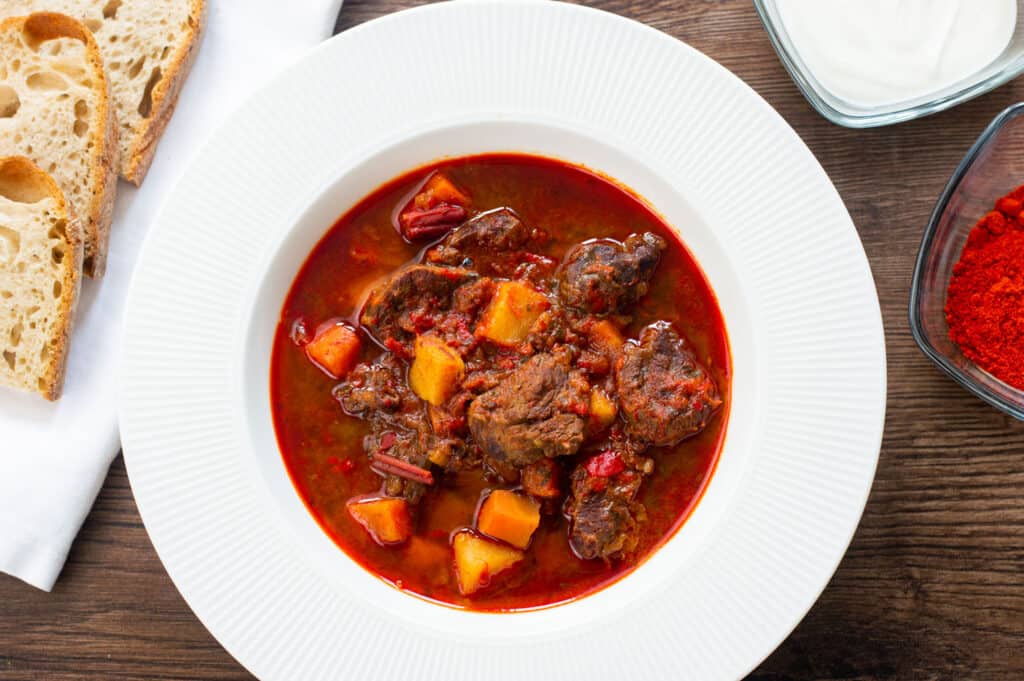
This Hungarian goulash recipe uses traditional ingredients that are slowed cooked in the slower cooker until the meat becomes tender and the stock has developed flavour. It takes a long time to break down collagen in tough cuts of beef used in goulash, which is why the slow cooker is ideal for this recipe.
Why Not Use Lean Cuts of Beef Instead?
The collagen in tougher meats plays a crucial role in developing a rich stock. When slow cooking, collagen in meat is broken down into gelatine which thickens and adds richness to your stock. Therefore there is no need for additional thickeners like flour or cornstarch.
What Does this Slow Cooker Hungarian Goulash Taste Like?
This slow-cooked Hungarian goulash has a rich spiced taste with a depth of different flavours. It has a mild sweetness from the pork fat, paprika and red pepper and richness from the browned onions, beef shin and stock. This richness and sweetness is then balanced out with fresh herbs and tender vegetables.
When Is a Good Time to Cook This?
Anytime! This recipe is delicious and eaten all year around. I personally like to cook this on a weekend when I can spare 20 minutes of prep time in the morning. Then it’s excellent; I just let it cook away with no worries about needing to make lunch or dinner later that day.
Do I Have To Use a Slow Cooker?
No, you don’t. You can swap the slow cooker with a large pot with a lid and apply just a few small tweaks.
- Use a large pot with a lid instead of the slow cooker
- Cook the goulash on a low to very low heat until it’s barely simmering.
- Stir every 30 to 60 minutes.
- Cook until the meat is tender, approximately 4-6 hours.
Why Did I Use a Slow Cooker?
I used a slow cooker to make the recipe easier and more full-proof. The heat is well rounded and never catches on the bottom, and because of this, you don’t have to stir the goulash.
There are no worries about catching or overcooking, simply set it and forget it. Once the timer has finished, it will stop cooking and place the goulash in hot hold mode.
What Type of Slow Cooker Should I Use?
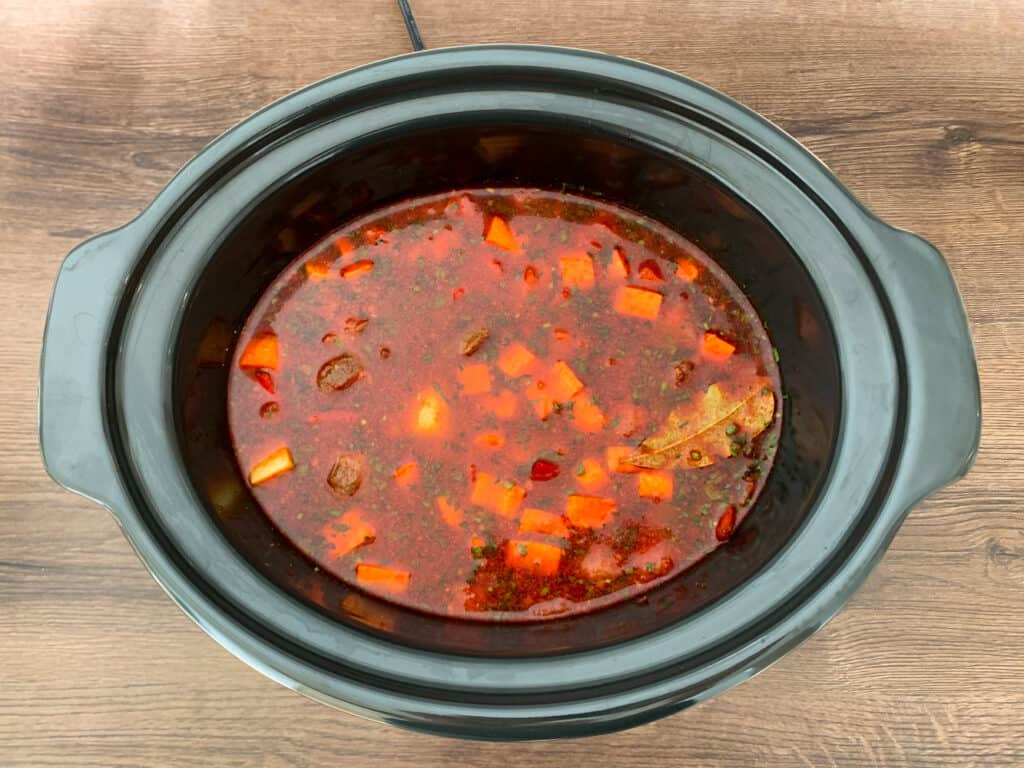
Make sure to use a good quality slow cooker. I am currently using a 3.5L slow cooker which works perfectly for this batch size. The slow cooker was about half full, which left me a little room if I wanted to increase the batch size for next time.
For most recipes, it’s a good guideline to have the slow cooker around 50% to 75% full to avoid under or overcooking. Use these ingredient ratios as a guideline when cooking in different slow cooker sizes.
- 2L Slow Cooker: Use 0.66 to 1 ratio
- 3.5L Slow Cooker: Use 1 to 1.5 ratio
- 5L Slow Cooker: Use 1.5 to 2 ratio
Traditional Ingredients and Replacements
Since I’m currently 45 minutes from the Hungarian border whilst making this recipe, the traditional ingredients are really easy to pick up. If you can’t find all the ingredients and need to make a few tweaks, don’t worry, I will give you the best replacement possible for each harder-to-get ingredient.
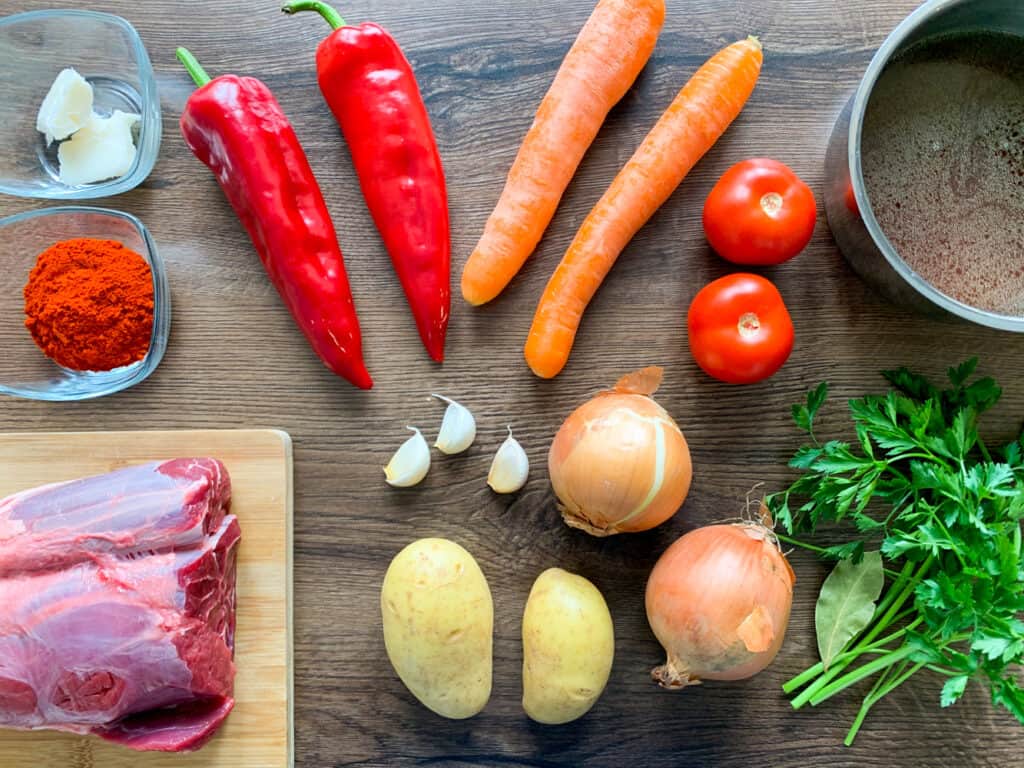
Pork Fat is very popular in Hungary, it adds richness and sweetness to the goulash. – The best alternative would be Neutral Cooking Oil like Canola or Vegetable Oil.
Beef Shin is an excellent choice of meat; it’s reasonably cheap and has a lot of collagen that breakdown into gelatine whilst cooking, which adds richness.. – The alternative is Beef Chuck; this is also a great choice and has a similar cooking time.
Hungarian Red Peppers are flavourful & slightly spicy peppers. The best alternative is the less hot red peppers; the red banana peppers or red bell pepper are a good choice.
Hungarian Paprika has a delicious depth of flavour; you can either use ‘sweet’ or ‘spicy’ Hungarian paprika. The best replacement would be regular paprika for the ‘sweet’ version and regular paprika with a 1/2 tbsp cayenne pepper for the ‘spicy’ Hungarian paprika.
What Makes Goulash Traditional?
Goulash originates from Hungary and has been around since the 9th century. The recipes have been slowly tweaked and refined over time. It wasn’t until the 16th century when paprika was added, which is now considered one of the most important flavours of goulash.
16th Century Goulash
- Paprika
- Hungarian Red Pepper
- Potatoes
20th Century Goulash
- Tomatoes
- Csipetke (optional)
- Caraway Seeds (optional)
Ingredients not in Goulash
- Flour or Cornflour
- Ground Beef
- Macaroni
- Cheese
In the 4 years I spent travelling & living around Hungary, Slovakia, the Czech Republic and Austria, I have never seen a recipe with macaroni, ground beef, cheese or flour. I have also worked inside prestigious 5-star hotels with Hungarian chefs, and they can confirm that it’s not a thing.
This type of goulash is more of a ‘Spag Bol’ with the addition of a pinch of paprika and swapping the spaghetti for macaroni. To me, this is more of an American Italian pasta dish, which is something completely different to this recipe.
Step by Step Instructions
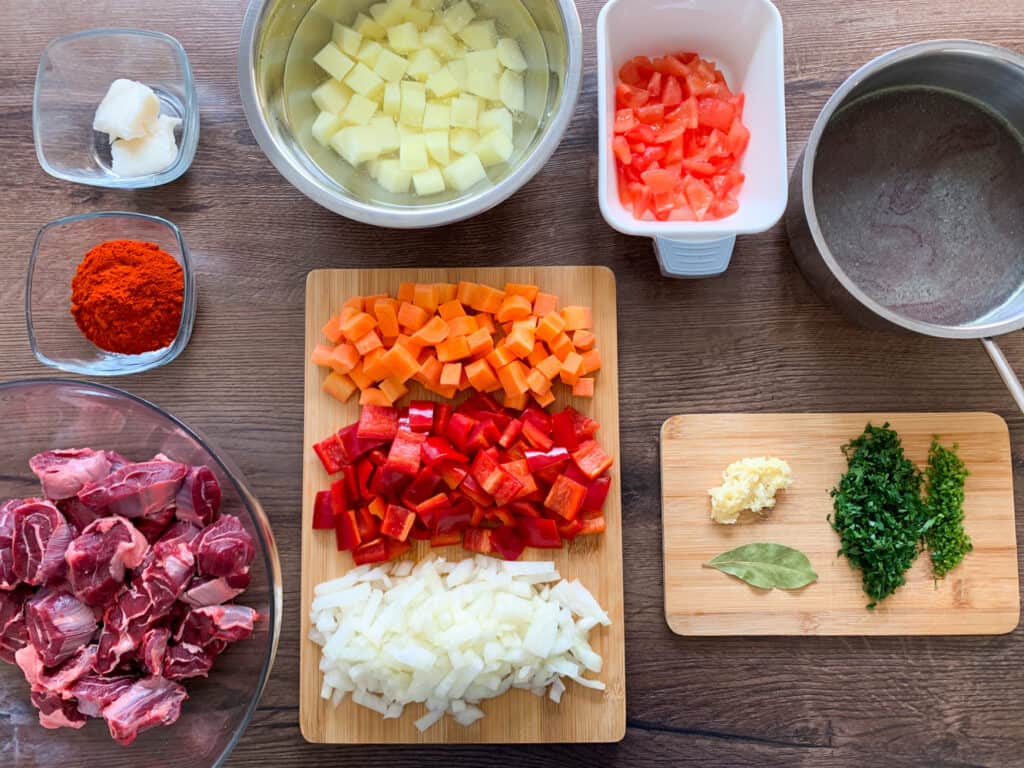
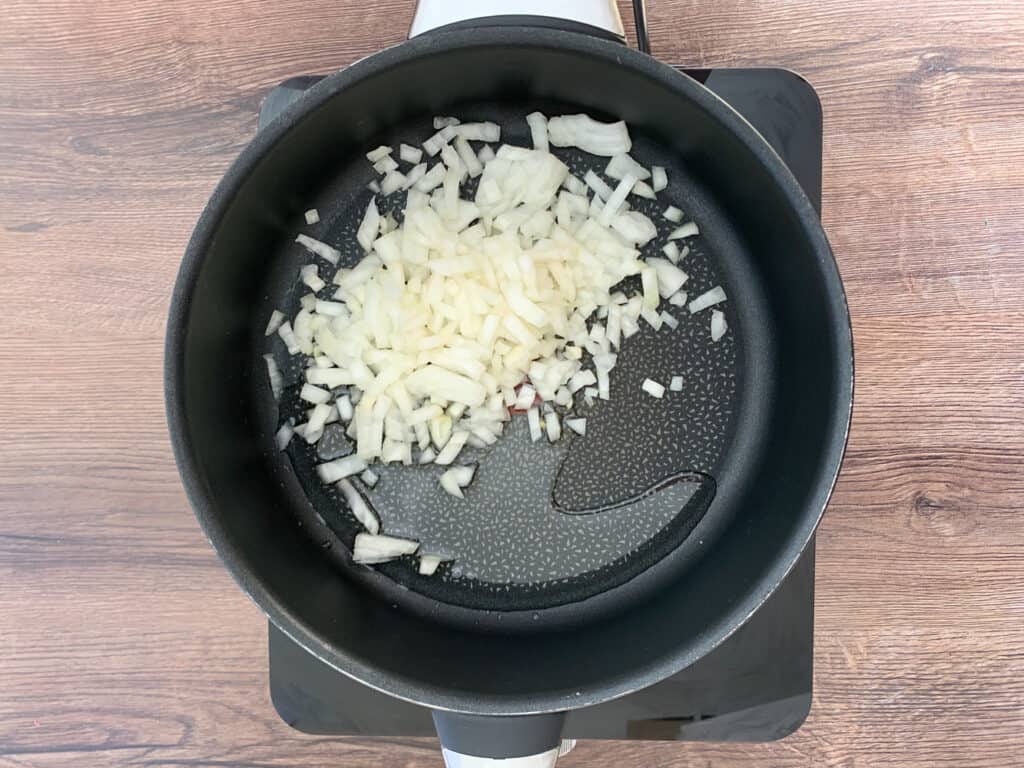
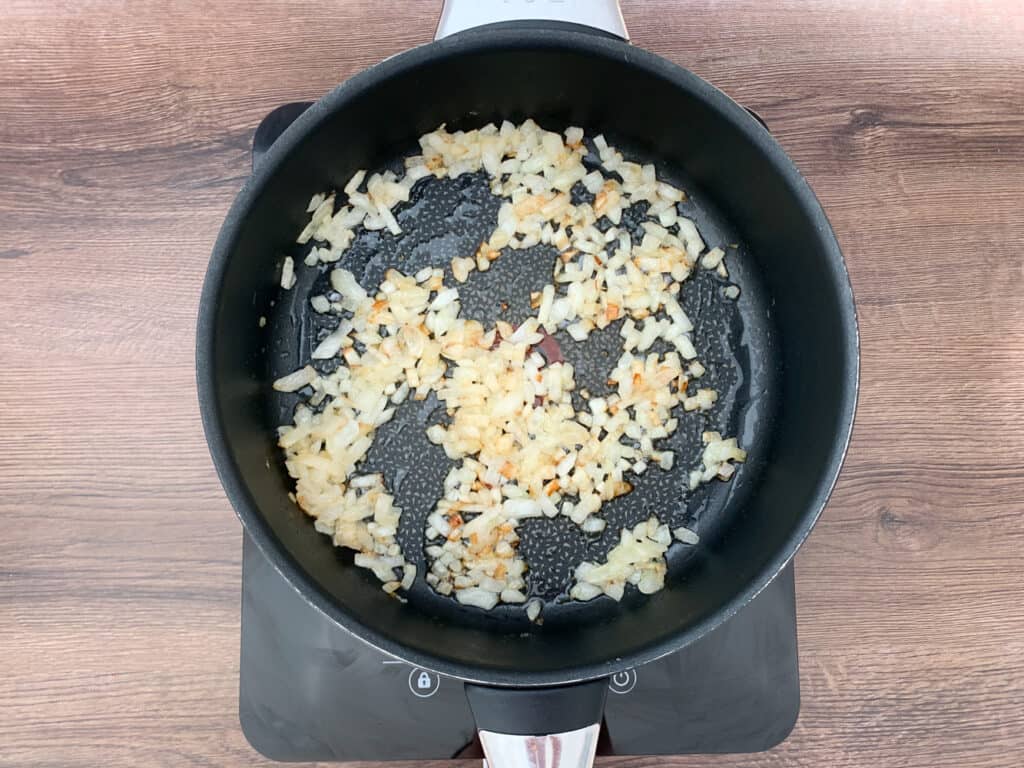
1) Melt the pork fat in a large deep sauté pan over medium-high heat. Add the onions and brown them for 5 to 7 minutes.
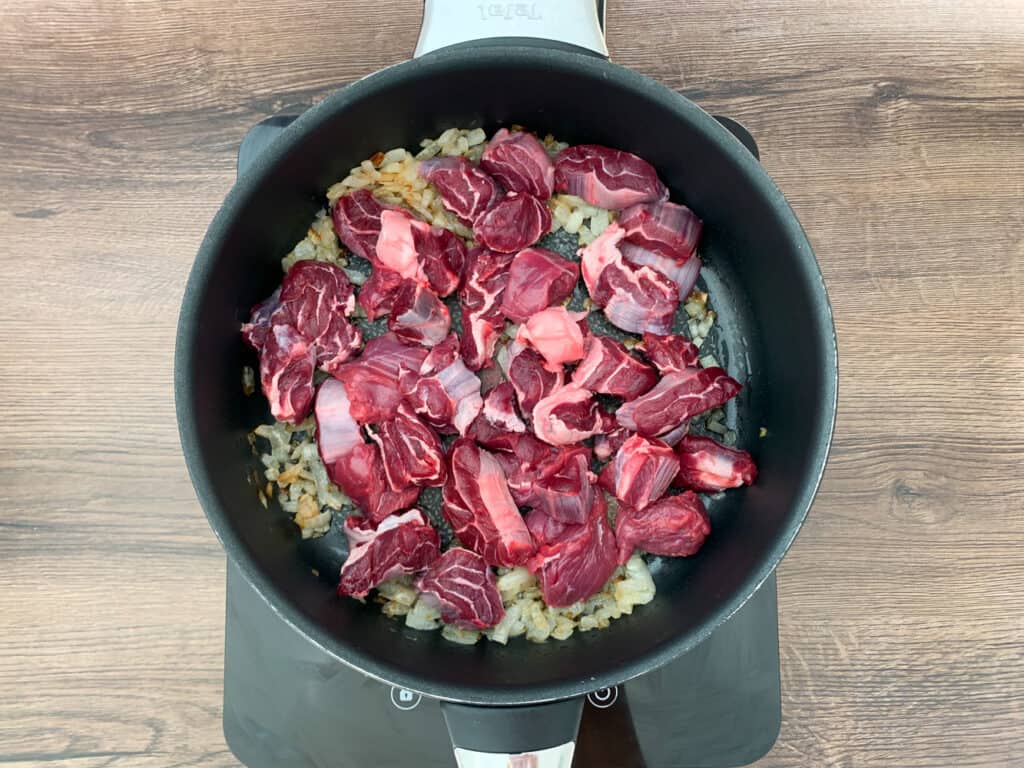
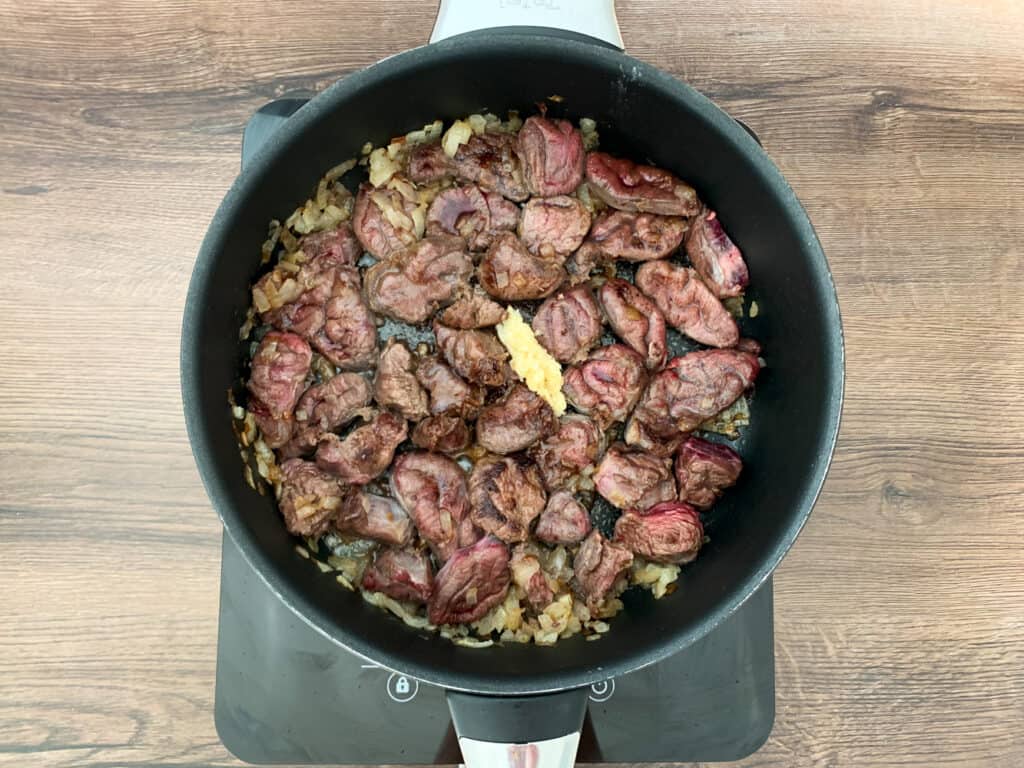
2) Turn up the heat, add the beef and season with salt and pepper. Sear the beef on each side, this will take 3 to 4 minutes. Add the garlic, mix and sauté for 30 to 45 seconds.
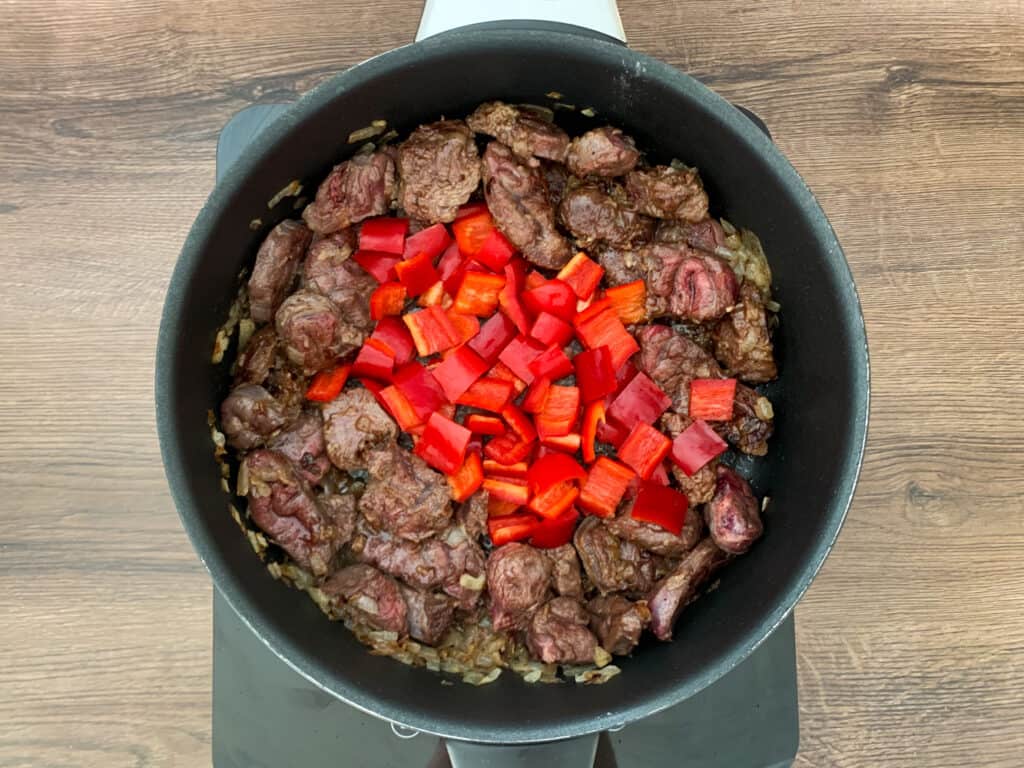
3) Add the Hungarian pepper and sauté for 3 to 5 minutes, until slightly softened.
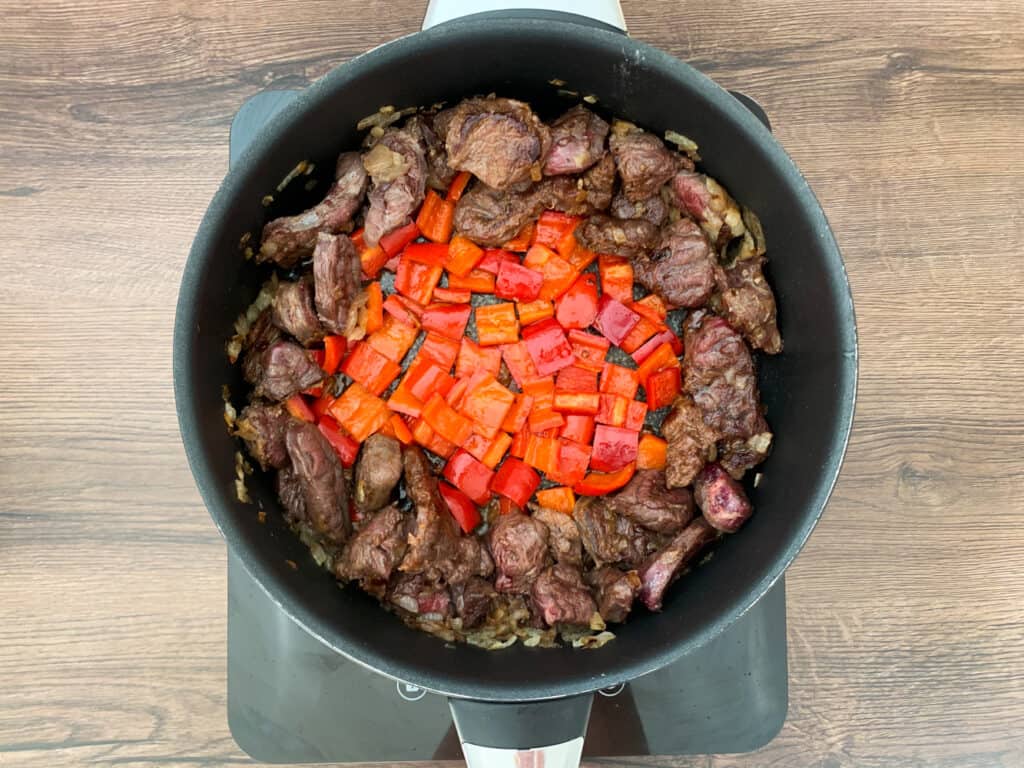
4) Turn off the heat, add the Hungarian paprika and mix thoroughly. Let the residual heat toast the paprika.
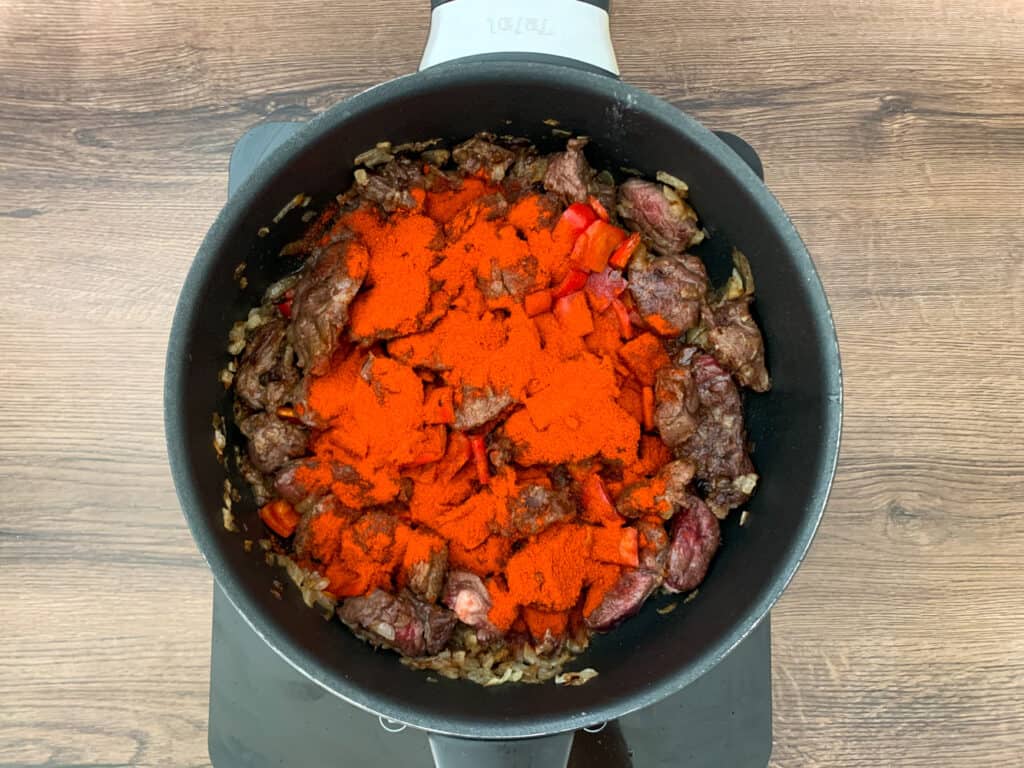
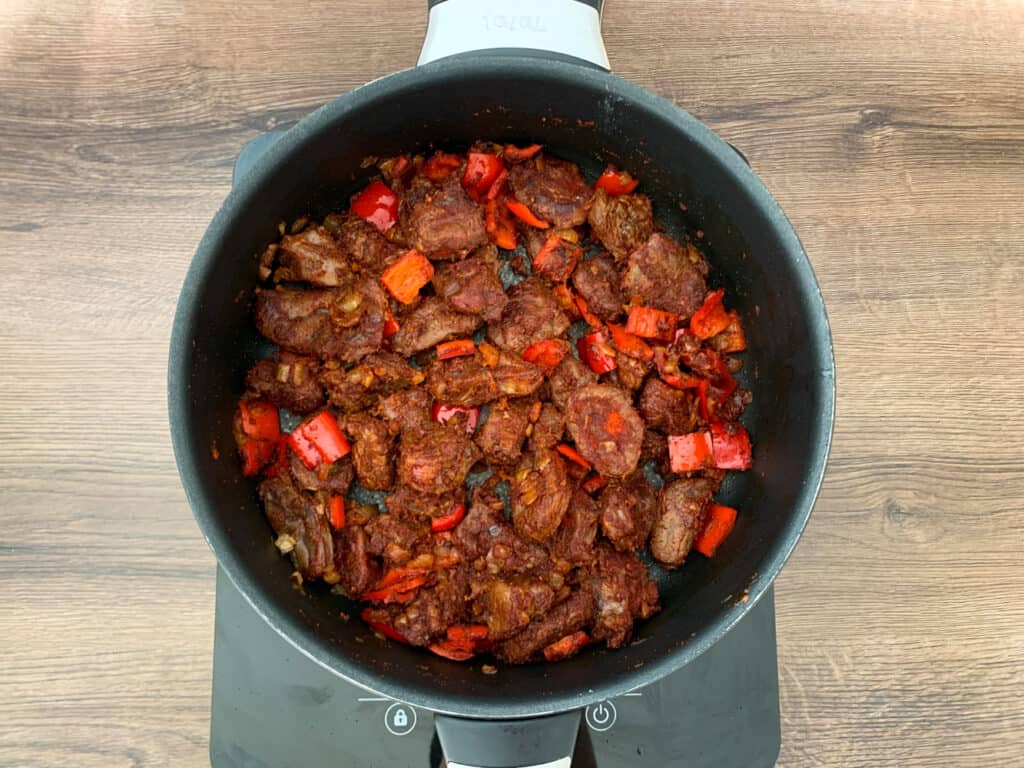
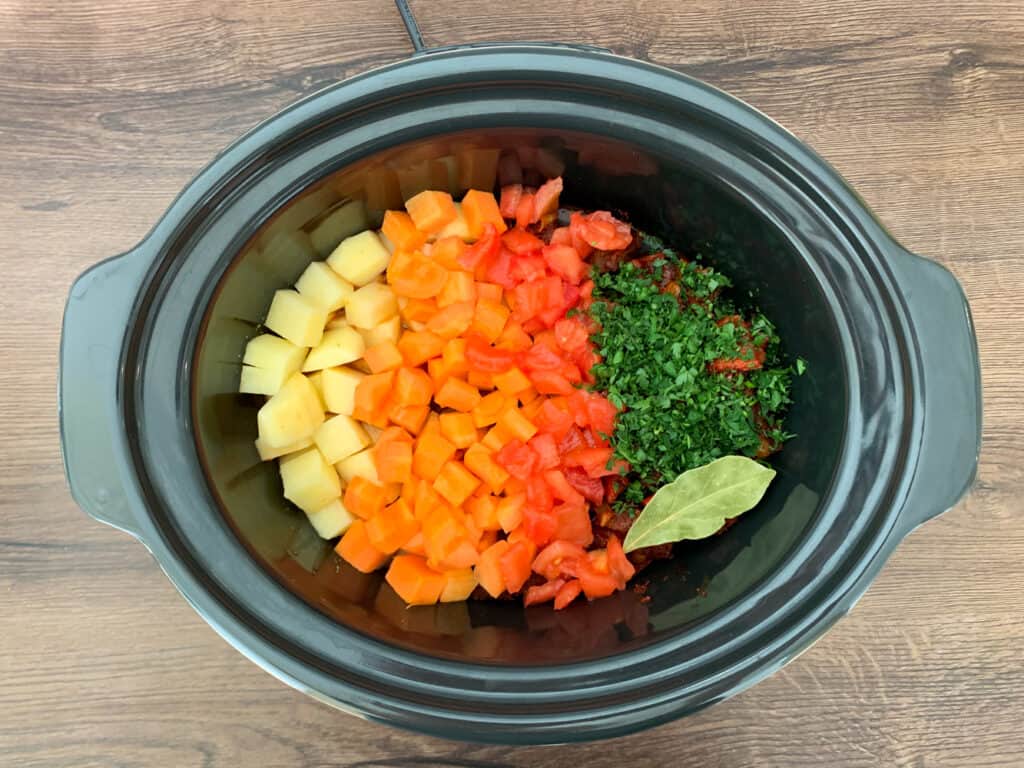
5) Add all the ingredients into the slow cooker. Place on high for 4 to 6 hours, or low for 8 to 10 hours.
More Recipes You May Like…
Traditional Slow Cooker Hungarian Goulash

Equipment
Ingredients
- 2 tbsp Pork Fat or oil
- 2 Onion diced
- 4 cloves Garlic minced
- 2 Hungarian Red Pepper deseeded and cut into chunks
- 800 g Beef Shin or beef chuck sliced
- 2 Tomatoes deseed and diced
- 2 Carrots cubed
- 2 Potatoes cubed
- 4 tbsp Hungarian Paprika sweet or spicy
- 800 ml Beef Stock
- 1 bunch Flat Parsley Leafs and Stalks finely sliced
- 1 Bay Leaf
- Sea Salt & Pepper
Instructions
- Melt the pork fat in a large deep sauté pan over medium-high heat. Add the onions and brown them for 5 to 7 minutes.
- Turn up the heat, add the beef and season with salt and pepper. Sear the beef on each side, this will take 3 to 4 minutes. Add the garlic, mix and sauté for 30 to 45 seconds.
- Add the Hungarian red pepper and sauté for 3 to 5 minutes, until slightly softened. Turn off the heat, add the Hungarian paprika and mix thoroughly. Let the residual heat toast the paprika.
- Add all the Ingredients into the slow cooker. Place on high for 4 to 6 hours, or low for 8 to 10 hours.

I add German Sauerkraut, caraway seeds, and don’t use carrots or potatoes..
Making this now… should I stir it inbetween the hours or just let it sit the whole time?
I’ve made it both with stirring and without, and it works well either way. Generally with slow cooking, it’s nice if you can give it a stir halfway through, but it’s definitely not mandatory.
How long can it be kept in refrigerator??……..freezer??
Thank you.
I had fun making this and thinking of my visit to Budapest!!
I’m so glad you enjoyed making the goulash! It keeps well in the fridge for about 3–4 days, or you can freeze it for up to 3 months. The best way to reheat it is gently on the stovetop (just like they do in restaurants), but using the microwave works too. A lot of locals say it tastes even better the next day.
Thank you for the Slow Cooker recipe! I grew up in Germany, been living in the US for 60plus years. Am in my 80’s & love, love Goulash. I do usually leave out the potatoes, because I prefer to thicken mine with a bit of flour and serve over pasta…
Depending on what I have on hand, I may also substitute fresh tomatoes with tomato paste, add some red wine, or even bacon during the browning process….Of course I use lots of (SZEGED) Hungarian Style Paprika, there is a difference in flavour!…Can’t go wrong with Goulash…have some in the slow cooker, as I am writing!…The smell permeating the house…wonderful!!!….Can barely wait till dinner!
Making for Boxing Day family feast with I Osztalyu Fuszer paprika bought specially. Expctations and anticipation are high!
I hope your Goulash goes well. I just had it last week, and it was delicious; this is still my go-to recipe even after years of publishing it. Happy Holidays!
I’m really looking forward to trying this recipe for goulash.
Looks amazing.
I’m from the UK and have family friends living in Mannheim Germany and they made a goulash while I was staying with them and thought what a wonderful meal it was so have been looking out for a good recipe to try and this seems to be the one for me.
Thank you.
I hope your goulash turned out wonderfully! There are so many variations of goulash—Hungary itself has at least nine, and Germany has I believe at least five. I’m curious which type of goulash your friends made for you in Germany! This recipe reflects the most typical Hungarian variation (Gulyás) that you’ll often find in Hungarian restaurants. Let me know how it compares to the one you had!
While it’s hard to beat goulash from some restaurant alongside the Danube, this sure comes close. If course, like any “traditional” dish, there are as many variations as there are households in Budapest.
Thank you. I’ll take that as a huge compliment! There really are some incredible goulashes to be found around the Danube. I visited Budapest again in October and had two amazing ones plus my favorite so far, and this was my fifth trip to Hungary!
I may need to look at working on a stovetop-only recipe next!
Planning to try out this recipe at the start of the new year once I acquire a slow-cooker, wow it sounds quite delicious, thank you for sharing!
No problem! Thank you for commenting 🙂
I ended up using minced beef anyway because of the cost of living and beef being very expensive, and it still tasted as good as the original. Followed the rest of this recipe exactly 🙂
This is perfection. Having lived in Prague and spent several yearly holidays to Austria.. this is the real deal. So easy and satisfying. I think the prep time is longer…but all worth it. Definitely should be served with warm dark bread and some pickles. Thank you for sharing, this is a keeper!
Thank you Mandi, I’m really glad you like it! I visited Prague 4 years ago, it’s such a beautiful city. I’ve been meaning to go back and take my family there!
No mention of stock in the instructions l
Hey Irene,
The stock is included in the start of step 4 “Add all the Ingredients into the slow cooker”. I hope you made the recipe okay!
Jack
Hey Jack, it looks like the only TRADITIONAL recipe I’ve found for my slow cooker. I still remember the flavours of the goulash I´ve tried in Czech Republic a few years ago. Looking forward to try it in Argentina!
Thank you Ariel :),
I hope you enjoyed it! They have some good meat in Argentina!
Jack
Works well in a slow cooker. I’ve used pork instead of beef and this works just as well.
Thanks Marion, I’m glad you enjoyed it! Pork is the go to next door in Slovakia :), they love it!
@Jack Slobodian, I was taught that pork is the protein used in Hungarian goulash; why? there are more pig farms in Hungary that cattle farms, so pork is the more readily available meat and is cheaper too. This last point is important in that money is a problem in Hungary for those living in the countryside (where the recipe originally came from apparently).
Also taught that prior to serving, put 1/2 pint of sour cream in the pot; stir and then then slow cook for another 20 minutes
Hi Trevor,
I appreciate your interest in Goulash :).
Traditional goulash is tricky because the recipe has been prepared for around a millennium (about 600 years before sour cream was invented).
You’re right that sources say goulash did originate from the countryside. Still, sources also say that the Hungarian Sheperards used Sheep stomachs. Which I guess was to avoid wasting produce, and not what our modern day folk want.
I’ve lived in Central Europe for over 4 years and I revisited Hungary just a couple months ago. Whenever I speak to local folk, beef is the most common answer (and I’ve worked in restaurants with multiple Hungarian chefs).
But again, due to the number of adoptions and history behind goulash, there is no one fits all ‘this is only traditional’ recipe. I think you can have a traditional goulash with many types of meat including beef, pork, veal, lamb or even sheep’s stomach aha: Yum.
I know Slovakia (the northern border country to Hungary) uses pork as their primary choice for goulash in their restaurants, and that’s what many of their locals say is traditional.
Also, you tend to find the sour cream is a topping, being heaped on top of the goulash just before serving (the goulash should be brothy).
Delicious …add polenta (white or yellow) if you like, for a super filling winter meal!
Thanks Federica,
That sounds like a delicious idea! Glad you enjoy it!
Jack
Phenomenal!
Thank you!
Hey tried this recipe yesterday shall definitely cook it this away again added a couple of extra ingredients though 1/2 teaspoon of cayenne pepper because I like the heat and had to ad a tablespoon of red wine vinegar to balance out the sweetness from the sweet paprika 👨🍳✅👍
Hey Mike,
Excellent work with the flavour balancing. The sweetness all depends on the type of peppers/paprika used. If you were to use sweeter paprika or sweeter red peppers like bell pepper, it would be a little sweeter than usual.
(For other readers: make sure to simmer the red wine vinegar a little before serving, if you plan on adding any)
My partner also loves it with a kick of heat! I sometimes find it served with some added spice in Slovakia, just below Hungary.
I’m glad you enjoyed the recipe, and thank you for the comment!
Jack
I’ve cooked and eaten many beef stews over the years but for some reason, have yet to try a traditional Hungarian goulash. Looking forward to trying your recipe. Great process photos!
Hey Jill,
Thank you! I was exactly the same as you! Me and my family love beef stews but it wasn’t until I lived and travelled through Europe before trying my first Hungarian goulash. I must have tried at least 50 after being here for over 3 years, and this is my favourite recipe so far.
So I hope you enjoy it!
Jack
Wow, this goulash is divine! Slow cooking the beef really added such a wonderful richness to the broth. It was total comfort food.
Hey Amanda,
Thanks! Yes, the beef is hugely important for the broth, I love to find a well-marbled beef to use.
I’m glad you enjoyed it,
Jack
I’m so excited to see this recipe. My Oma used to make it for me as a kid, and now I can make it for my own kids! Love the flavors in this – I’m already salivating!
Hey Jenn,
Thanks for the lovely comment. I’m glad you found a recipe that you find so appealing! I hope it tastes as good as it sounds.
Jack
Oh yum! This looks so hearty and flavorful! The perfect comfort food. 🙂
Thanks Carrie, I’m glad you like it!
Jack
My great grandparents came straight from Hungary and used to make a Goulash very similar to this all the time! I never got their recipe, though, so this is a great way to make it again for my family.
Hey Stephanie,
A classic recipe from your grandparents is hard to beat! I hope this one will impress the family 🙂
Jack